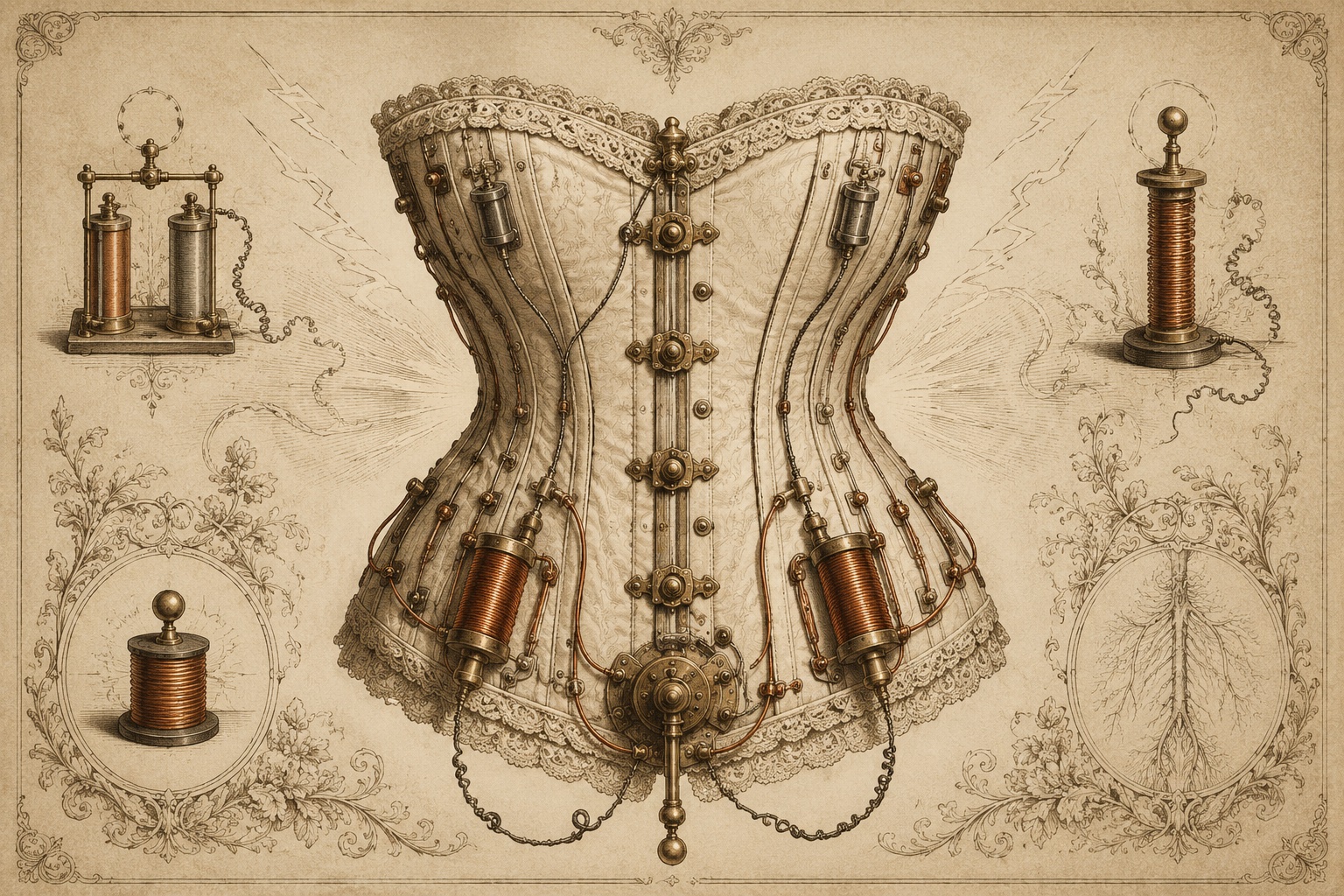
When Electricity Became A Wellness Brand
In the late 1800s, electricity was not just a technology. It was a mood.
Electric lights were glowing. Telegraphs were shrinking the world. Inventors were wiring up cities, homes, and occasionally, very questionable underwear. To the Victorian public, electricity felt futuristic, mysterious, and powerful enough to fix almost anything.
So naturally, someone looked at the corset — already one of history’s most aggressive fashion choices — and thought, “What if this also healed people?”
Enter the electric corset.
These garments were marketed as beauty aids, posture correctors, circulation boosters, nerve stimulators, and general wellness devices for women. They promised relief from back pain, weakness, fatigue, “female complaints,” and other wonderfully vague ailments that old medical ads loved to wave at like a haunted handkerchief.
It was the perfect product for an age obsessed with both body-shaping and scientific progress.
A corset that squeezed your waist was fashion.
A corset that squeezed your waist while claiming to improve your nervous system? That was innovation.
The Corset Gets A Current
The electric corset belonged to a much larger craze for medical electricity. Some doctors were genuinely studying electricity for legitimate medical uses, but the advertising world did what advertising worlds do best: it took a real scientific idea, put a top hat on it, and marched it directly into nonsense.
Suddenly, there were electric belts, electric hairbrushes, electric baths, electric insoles, electric flesh brushes, and electric garments promising to restore health through mysterious currents.
One of the best-known examples was Dr. Scott’s Electric Corset, which appeared in American advertisements in the 1880s. Some ads promoted versions ranging from $1 to $3, making the miracle of “electric” wellness available to women at different price points. The ads leaned heavily on scientific-sounding claims, assuring buyers the corsets were built on therapeutic principles and backed by medical logic.
Across the Atlantic, a major player was Cornelius Bennett Harness, founder of the Medical Battery Company in London. Harness sold electropathic belts and related devices, including an electric corset aimed at women. According to The Quack Doctor, Harness’s main product was an electropathic belt containing zinc and copper plates that were supposed to create a health-giving current.
This was not subtle marketing.
It was health, fashion, science, and salesmanship, all tightly laced together.
Was It Actually Electric?
Here is where things get even better: some “electric” corsets were not especially electric.
Harness’s version, for example, was reportedly more magnetic than electrical. The corset included a magnetized steel busk — the stiff front closure of the garment — rather than anything resembling a modern powered device. But “Magnetized Steel Busk Corset” does not exactly leap off the page.
“Electric Corset,” however, sounds like the future has arrived and it is here to improve your posture.
That was the trick. Electricity had become a magic word. It suggested progress, energy, science, and invisible forces working in your favor. Customers did not need to understand the mechanism. They just needed to believe the sensation of modernity had been stitched into the garment.
And if the product contained a few metal bits? Even better.
That made it feel official.
The “Female Complaints” Business Model
Victorian medical marketing was especially interested in women’s bodies, often in the least helpful way imaginable. Advertisements regularly used vague terms like “female weakness,” “nervous complaints,” and “ailments peculiar to women.” These phrases could mean almost anything, making them incredibly convenient for selling almost anything.
The electric corset slid neatly into that market.
It promised support, vitality, circulation, and relief. It also played into the era’s complicated relationship with corsets themselves. Critics argued that tight corsets could damage health, restrict breathing, and limit movement. But the electric corset tried to flip that concern on its head.
What if the corset was not hurting you?
What if the right corset was healing you?
It was a brilliant little marketing twist. The discomfort was no longer a flaw. It was part of the treatment plan.
Basically, “Yes, it is squeezing your organs, but scientifically.”
The Harness Problem
Cornelius Bennett Harness built a thriving business around electrical health devices, but his empire eventually ran into trouble.
His electropathic belts promised relief from a wide variety of conditions, including nervous complaints, indigestion, sleeplessness, and other health problems. The National Archives describes Harness’s medical belt as a misleading Victorian medical device and notes the broad curative claims attached to it.
The trouble deepened in the 1890s. In one notable case, a customer sued after buying a Harness belt to treat a hernia. According to Atlas Obscura, the man’s condition reportedly worsened, and the lawsuit helped expose the shaky claims behind the business.
By the early 1890s, the Medical Battery Company was battered by criticism, court cases, and press attention. The whole thing became a cautionary tale about what happens when public fascination with technology meets medical advertising with very few brakes.
Bad Science, Excellent Branding
The electric corset seems ridiculous now, but it worked because it borrowed the look and language of science.
The ads talked about currents, nerves, circulation, vitality, and therapeutic design. They invoked experts. They promised modern relief for modern bodies. They made customers feel like they were not buying a gimmick, but joining the future.
That is what made the electric corset so persuasive.
Victorians were not uniquely gullible. They were living through a real technological revolution. Electricity truly was changing the world. So when advertisers claimed it could also improve health, beauty, posture, and feminine wellness, it did not sound absurd to everyone.
It sounded possible.
That is the uncomfortable little jolt at the center of the story. The electric corset is not just an antique oddity. It is an early example of a pattern we still recognize: take a real breakthrough, surround it with impressive language, and sell it as a cure-all.
Today, we may laugh at an electric corset.
But we still have wellness gadgets, miracle wearables, “detox” tools, magnetic accessories, and products that sound scientific mostly because the packaging owns a thesaurus.
The Final Jolt
The electric corset was fashion, medicine, and marketing all strapped into one stiff little package.
It promised women beauty, posture, vitality, circulation, and relief from mysterious ailments. What it actually delivered was much less certain — unless we count excellent historical comedy, in which case it overperformed.
It remains one of the best examples of the 19th-century belief that electricity could fix everything. Tired? Electricity. Weak? Electricity. Bad posture? Electricity. Existing as a woman in a medically confused century? Please step into this electrified corset and let science give you a hug with metal ribs.
In the end, the electric corset tells us something timeless: every era has its miracle word.
For the Victorians, it was electricity.
For us, it might be quantum, detox, biohacking, or AI-powered.
The technology changes.
The sales pitch just gets better lighting.
Sources
- The Quack Doctor — “The very thing for ladies: Harness’s Electric Corset”
- The National Archives — “A misleading Victorian medical device”
- Atlas Obscura — “The Victorian Tool for Everything From Hernias to Sex — a Vibrating Electric Belt”
- Underpinnings Museum — Electric Corset & Electropathic Belt Promotional Materials