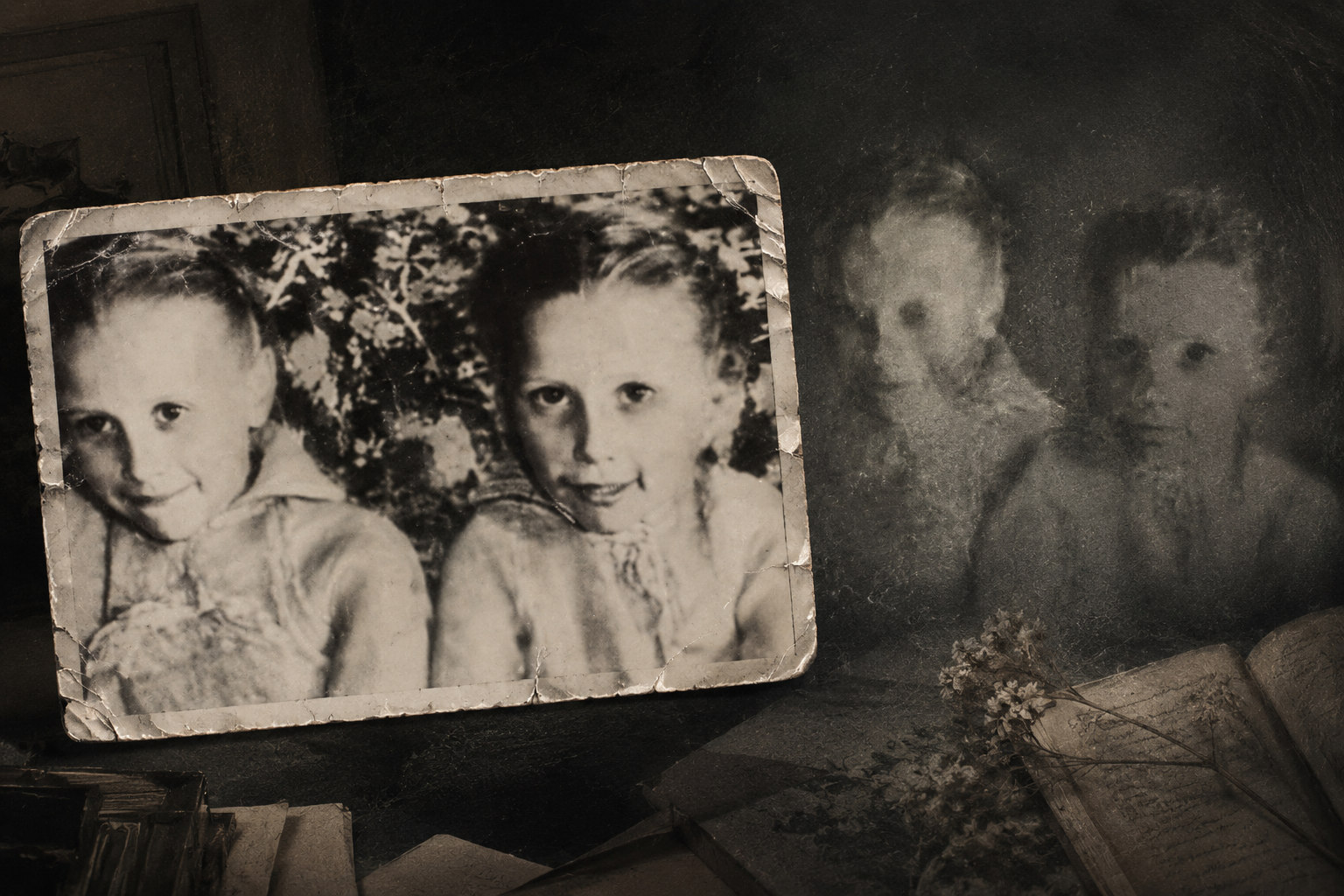
On a spring morning in 1957, in the market town of Hexham, England, two young sisters set out for church and never came home.
Their names were Joanna and Jacqueline Pollock. Joanna was 11. Jacqueline was 6. They were walking with a friend when a car came off the road and struck them. All three children were killed.
It was the kind of tragedy that permanently divides a family’s history into before and after. Before the accident, John and Florence Pollock had two daughters. After it, they had an empty house, a grief no parent should have to carry, and a father who became convinced the story was not over.
John Pollock believed in reincarnation. Florence, by most accounts, did not share the belief with the same intensity. But after the deaths of Joanna and Jacqueline, John reportedly insisted that the girls would return to the family. Not symbolically. Not in dreams. Literally.
Less than a year later, Florence became pregnant.
Doctors reportedly told the family to expect one baby. John, however, insisted there would be twins.
On October 4, 1958, Florence gave birth to twin girls: Gillian and Jennifer Pollock.
That alone would have been enough to shake the family. But what happened next turned the Pollock twins into one of the most famous and unsettling reincarnation cases ever studied.
The Twins Who Arrived With Familiar Marks
From the beginning, the family noticed something strange about Jennifer, the younger of the twins.
According to accounts later collected by psychiatrist Ian Stevenson, Jennifer was born with markings that seemed to echo features associated with Jacqueline, the sister who had died. One mark was reportedly on her waist or hip area, similar to a birthmark Jacqueline had. Another was described as a pale line on her forehead, which the family connected to an injury Jacqueline had suffered.
Birthmarks, of course, are not proof of anything supernatural. Families can see patterns where grief desperately wants them to exist. But in the Pollock case, the marks became part of a larger and much stranger pattern.
The most detailed summary of the case comes from the Psi Encyclopedia’s account of the Pollock twins reincarnation case, which describes how Stevenson learned of the story through newspaper coverage in 1963, then visited the family, interviewed the parents, and examined the girls when they were still young.
By then, the twins had reportedly begun to do more than simply resemble the dead sisters.
They were saying things.
And some of those things were difficult for the family to dismiss.
The Toys They Should Not Have Known
When Gillian and Jennifer were still small children, their parents brought out toys that had once belonged to Joanna and Jacqueline.
The twins reportedly recognized them.
Not in the vague way that any child might gravitate toward an old doll or stuffed animal, but specifically. According to the story, they seemed to know which toys had belonged to which sister. They allegedly called them by names or identified details that belonged to Joanna and Jacqueline’s lives before the accident.
That is where the Pollock story begins to feel less like a sad family coincidence and more like something pulled from a ghost story.
The twins reportedly described places, toys, and memories belonging to the dead girls that they had never known firsthand.
The obvious skeptical question is whether they truly “never knew” those things. Children overhear more than adults realize. Grieving parents talk. Relatives visit. Objects carry stories. Even small details can be absorbed, repeated, and later remembered as if they appeared from nowhere.
But the Pollock family claimed they had not told the twins these details. And Stevenson, who spent much of his career studying children who claimed to remember previous lives, considered the case worth documenting.
The Return To Hexham
One of the most repeated parts of the Pollock twins’ story involves a trip back to Hexham.
After the accident, the family had moved away from the town. Gillian and Jennifer were babies when they left, too young to consciously remember streets, landmarks, or the area’s layout.
Yet when the family later returned, the twins reportedly recognized places associated with Joanna and Jacqueline’s lives.
They allegedly knew the way to a park. They reportedly recognized the school or the surrounding area. They seemed familiar with locations their parents believed they should not have known.
Again, this is the kind of detail that sits right on the border between eerie and explainable. A believer sees evidence of memory carrying across lives. A skeptic sees parental influence, family storytelling, or a child’s ability to follow cues from excited adults.
But even if you strip away the supernatural interpretation, the image is chilling: two little girls walking through a town connected to the deaths of two sisters they had never met, behaving as if they had been there before.
“The Car Is Coming For Us”
The most haunting detail in the Pollock twins case involves their alleged reaction to traffic.
According to several retellings of the story, Gillian and Jennifer were once near a moving car when they became terrified and cried out that the car was coming for them. The moment has often been interpreted as a possible memory of the fatal accident that killed Joanna and Jacqueline.
This is also one of the details that requires the most caution.
Children can be afraid of cars. Parents who have lost children in a traffic accident may be especially alert to anything that sounds similar. A fearful outburst can be reshaped over time into something more meaningful. Memory is not a tape recorder, especially inside a grieving family.
Still, the reported incident became one of the reasons the Pollock case endured. The girls were not merely said to recognize toys or places. They were said to carry emotional echoes of the accident itself.
If true, that would be deeply strange.
If not, it still reveals something powerful about grief: how the dead can remain so present that even the living seem to move in their shadow.
The Researcher Who Took The Case Seriously
The Pollock twins case became famous largely because it drew the attention of Dr. Ian Stevenson, a psychiatrist at the University of Virginia.
Stevenson was not a tabloid ghost hunter. He was a medical doctor and academic who spent decades investigating reports of young children who claimed to remember previous lives. His work remains controversial, but it was far more systematic than most paranormal research. He interviewed families, collected statements, sought documentation, and tried to separate claims made before verification from those made afterward.
The University of Virginia Division of Perceptual Studies continues to describe this research area as involving children, often between ages 2 and 5, who speak about memories of a previous life and sometimes exhibit unusual behaviors, fears, preferences, or birthmarks that families believe are connected to those memories.
That age range matters because the Pollock twins’ alleged memories, like many similar cases, reportedly faded as they grew older.
By the time Gillian and Jennifer reached later childhood, the intense claims were said to have diminished. That pattern appears in many cases Stevenson studied: early childhood statements, followed by gradual fading around school age.
To believers, that suggests a soul slowly settling into its new life.
To skeptics, it suggests ordinary childhood fantasy and family reinforcement eventually giving way to age, social pressure, and more grounded memory.
The Problem With Proving A Story Like This
The Pollock twins case is compelling because it contains several ingredients that make reincarnation stories hard to casually dismiss: a documented death, a later birth, apparent physical similarities, alleged memories, and a researcher who took the claims seriously enough to investigate.
But it is not airtight.
Most of the evidence depends on family testimony. Stevenson arrived years after some of the earliest events were said to have occurred. That does not make the family dishonest, but it does mean the story passed through memory before it became research.
And memory, especially traumatic memory, is slippery.
Parents grieving two dead children may notice similarities that other people would overlook. They may unintentionally encourage certain statements. They may ask leading questions without realizing it. They may preserve the details that fit and forget the ones that do not.
The twins also grew up in the same family as the deceased sisters. Even if the parents avoided direct storytelling, the house itself may have carried the past. Photos, objects, relatives, and passing remarks could all transmit information.
That is the skeptical explanation: not fraud, necessarily, but grief, pattern-seeking, suggestion, and the ordinary ways family history seeps into children’s minds.
Still, there are details in the Pollock case that remain difficult to reduce neatly. That is why it has lasted for decades.
The best strange stories are not always the ones that prove the impossible. Sometimes they are the ones who refuse to sit comfortably inside the possible.
Reincarnation, Coincidence, Or A Family Haunted By Grief?
The Pollock twins story is often presented online as “proof of reincarnation.” That goes too far.
A more careful version is this: after two sisters were killed in a 1957 car accident, their mother gave birth to twin girls. Those twins reportedly had birthmarks, behaviors, and memories that their parents connected to the dead sisters. The case was later investigated by Ian Stevenson, who included it among his research into children who claimed to remember previous lives.
That is strange enough without overselling it.
The University of Virginia Magazine profile of Jim Tucker, who continued Stevenson’s line of research, notes that this field sits in an unusual place: studied by credentialed researchers, but still far outside mainstream scientific certainty. The cases are fascinating, but they do not provide the kind of controlled, repeatable evidence that would settle the question of reincarnation.
And maybe that is why the Pollock twins case remains so unsettling.
It is not simply a ghost story. It is not simply a tragedy. It is not simply a scientific case study.
It is a story about two children who died, two children who were born, and a family that believed the line between them had somehow blurred.
Maybe Gillian and Jennifer were ordinary twins raised in the emotional aftershock of an unimaginable loss.
Maybe their parents saw Joanna and Jacqueline because they needed to.
Maybe the twins absorbed fragments of family history and reflected them back in ways that seemed impossible.
Or maybe, as John Pollock believed, the sisters came home.
The case does not give us a clean answer. It gives us something stranger: a documented tragedy followed by a series of reports that are just specific enough to disturb, but not solid enough to prove.
The Pollock twins did not solve the mystery of life after death.
But they did leave behind one of the most haunting questions in modern paranormal history:
If a child remembers a life she never lived, where did the memory come from?
Sources
Psi Encyclopedia — “Pollock Twins Reincarnation Case”
University of Virginia Division of Perceptual Studies — “Children Who Report Memories of Past Lives”
UVA Magazine — “The Science of Reincarnation”
Ian Stevenson — Twenty Cases Suggestive of Reincarnation
Ian Stevenson — Children Who Remember Previous Lives