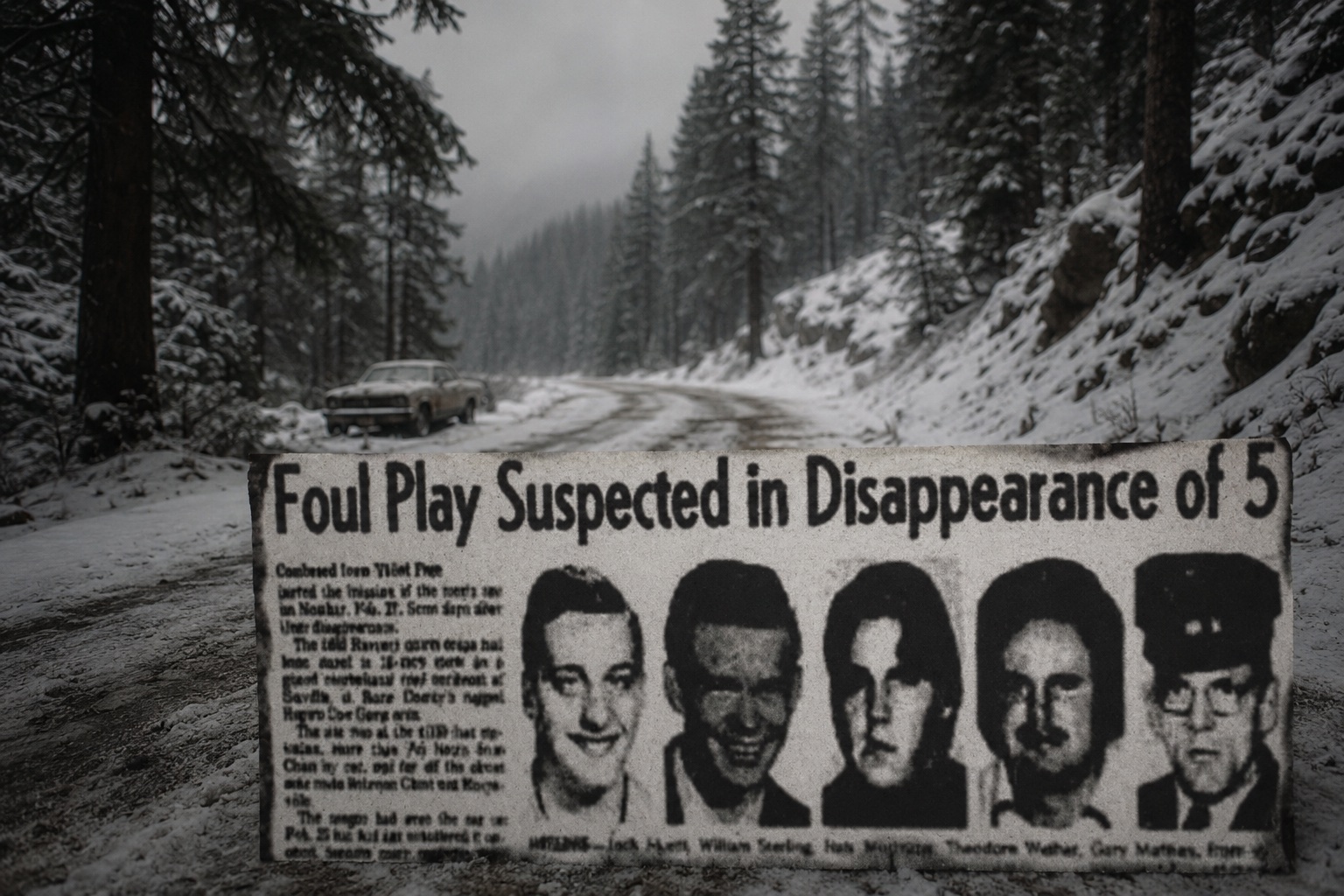
On the night of February 24, 1978, five friends from Northern California did something ordinary.
They went to a basketball game.
There was no grand plan, no whispered escape, no apparent trouble waiting in the wings. They were sports fans, teammates, and friends. That evening, they drove from the Yuba City-Marysville area to Chico to watch a college basketball game between UC Davis and Chico State. The next morning, they were supposed to play in a basketball tournament of their own.
Instead, by sunrise, all five were gone.
Their names were Jack Madruga, Bill Sterling, Ted Weiher, Jackie Huett, and Gary Mathias. Four would eventually be found dead in the Sierra Nevada wilderness. One, Gary Mathias, has never been found.
And nearly half a century later, the question still hangs over the case like cold mountain fog:
Why did five men heading home from a basketball game end up on a remote mountain road, miles from where they should have been?
A Night That Should Have Ended At Home
The five men were often described in contemporary coverage as “boys,” though they were adults aged 24 to 32. Several had developmental disabilities, and Gary Mathias had a history of schizophrenia, though by 1978 he was reportedly stable, taking medication, and considered to be doing well.
They were close friends. They loved sports. They played together on a team called the Gateway Gators, which was associated with a program for people with disabilities. The next day, they had a big game coming up, and by all accounts, they were excited.
That detail matters.
Families later said some of the men had prepared their basketball uniforms before leaving. This was not a group known for suddenly vanishing, drifting off, or deciding to improvise a late-night mountain adventure. They were expected home. They had something important to do the next morning.
According to later accounts, including reporting from The Washington Post, the group drove to Chico in Madruga’s turquoise-and-white 1969 Mercury Montego. After the game, they stopped at a market in Chico, where they bought snacks, sodas, and milk.
That was the last confirmed sighting of them alive.
Then the night took a turn no one has ever been able to explain.
The Car In The Mountains
When the five men failed to return home, their families quickly knew something was wrong. These were not men who would casually disappear overnight without calling. Police were contacted, and search efforts began.
Several days later, Madruga’s Mercury Montego was found abandoned in Plumas National Forest, high in the Sierra Nevada, on a remote mountain road near the Oroville-Quincy Highway.
This was instantly strange.
The car was not found on the normal route home from Chico to Yuba City. It was far out of the way, in a cold, snowy, isolated area. The men had driven into the mountains at night, in winter, wearing light clothing.
Even stranger: the car did not appear to be seriously disabled.
Investigators reportedly found it stuck in snow, but not destroyed, not crashed, and not out of gas. The vehicle could likely have been pushed free. Inside were signs of the ordinary evening they had just had: wrappers and containers from their snacks, and programs from the basketball game.
No one could say why the car had been driven there.
No one could say why the men had left it.
And at first, no one could find them.
The Witness In The Snow
One of the eeriest pieces of the case came from a man named Joseph Schons, who later told police he had also been on that mountain road the same night.
Schons said he had driven into the area to check snow conditions for a planned family trip. His own vehicle became stuck, and while trying to free it, he began experiencing symptoms he believed were a heart attack. He returned to his car and stayed there through the night.
According to accounts of the case, Schons later reported seeing lights and hearing voices nearby. He said he called for help but received no assistance. At one point, he reportedly saw a group of people and a vehicle, but when he yelled, the lights went out.
This sighting has become one of the most debated details in the case.
Was Schons seeing the five men?
Was someone else there?
Was he confused or impaired because of his medical emergency?
Like so much in this story, the answer is frustratingly just out of reach.
The Spring Thaw Reveals The Horror
Winter weather made the early search difficult. Snow, terrain, and the remote location limited what searchers could do. For months, the mountains held their secret.
Then, in June 1978, as the snow melted, the case shifted from a missing persons mystery to something much darker.
A group of motorcyclists came across a Forest Service trailer roughly 19 miles from where the Mercury had been found. Inside, they discovered the body of Ted Weiher.
The condition of the scene was deeply unsettling.
Weiher was found on a bed, wrapped in sheets. He had apparently survived for weeks, perhaps as long as several months, after the disappearance. His beard growth suggested he had lived far beyond the night the men vanished. He had lost a significant amount of weight. His feet were severely frostbitten.
The official cause was linked to starvation and exposure.
But the trailer was not empty.
There was food available. There were supplies. There were items that could have helped provide warmth. According to later reporting by The Sacramento Bee, the trailer and nearby storage areas contained rations, clothing, and heating options that raised agonizing questions about why Weiher still died.
Some food had been eaten. Some had not.
Some survival resources had been used. Others appeared untouched.
It was as if the trailer had offered a way to live, but the men either could not understand how to use it, could not access it, or were in such physical and psychological distress that survival became impossible.
More Bodies In The Wilderness
After Weiher was found, searchers returned to the surrounding area.
The remains of Jack Madruga and Bill Sterling were discovered along the road between the abandoned car and the trailer. Both were believed to have died from hypothermia. Their bodies had been exposed to the elements and scavenging animals.
Jackie Huett’s remains were later found northeast of the trailer. His father was reportedly among those who discovered parts of him, a detail so devastating it hardly needs embellishment.
Four men had been found.
Gary Mathias had not.
Mathias’s shoes were reportedly found in the Forest Service trailer, suggesting he may have reached it and survived for some time. But his body was never located. The Charley Project still lists him as missing.
That single fact is one reason the Yuba County Five case refuses to settle into a clear explanation.
If Mathias made it to the trailer, what happened to him afterward?
Did he leave wearing Weiher’s shoes?
Did he try to get help?
Did he die somewhere beyond the search area?
Or did someone else become involved?
Theories: Wrong Turn, Panic, Or Foul Play?
The simplest theory is that the men somehow took a wrong turn.
Perhaps they left Chico, became disoriented, and ended up driving into the mountains by mistake. Maybe they were trying to visit someone. Maybe they followed the wrong road and did not realize the danger until it was too late.
But that explanation has problems.
Madruga was said to be a careful driver who knew the area reasonably well. The route into the mountains was not a minor wrong turn of a block or two. It took them far from home, into increasingly dangerous terrain.
Another theory is that the men were frightened into driving there.
Something may have happened after the basketball game or at some point on the road. A confrontation, a threat, or some unknown pressure may have caused them to flee in the wrong direction. This theory helps explain why they might have abandoned a working car in the snow.
But there is no firm evidence of an attacker.
A third theory centers on confusion and panic. Once the car became stuck, the group may have believed they had no choice but to walk. In darkness, cold, and stress, decision-making can collapse quickly. For men with cognitive limitations, and for Mathias without access to his medication, a bad situation could have become catastrophic.
This is plausible, but still leaves hard questions.
Why walk nearly 20 miles into deeper wilderness instead of staying with the car?
Why not use the trailer’s heat and food more effectively?
Why were some supplies ignored?
Why did Mathias vanish completely?
The most honest answer is also the least satisfying: there may not be one single explanation. The tragedy may have been a chain of smaller failures — a wrong turn, snow, fear, disability, darkness, poor survival decisions, and bad luck — each one tightening around the group until escape became impossible.
The Case That Refuses To Sit Still
The Yuba County Five is sometimes called “America’s Dyatlov Pass,” a comparison to the infamous Soviet mountain mystery where hikers died under bizarre circumstances. The comparison is imperfect, but understandable.
Both cases involve people in a cold wilderness. Both include strange decisions that seem to defy basic survival instincts. Both have invited theories ranging from mundane to sinister.
But the Yuba County Five case is not just eerie because it is unexplained.
It is eerie because it began so normally.
Five friends went to a basketball game. They bought snacks. They had plans the next morning. Somewhere between the glow of a gymnasium and the black silence of a mountain road, their lives veered into a place no one has been able to map.
And the strangest part is not simply that they died in the wilderness.
It is that the clues seem to point in every direction at once.
A working car abandoned in snow.
A witness calling for help in the dark.
A trailer stocked with supplies.
A man who survived for weeks, only to starve.
Shoes belonging to the one man never found.
For the families, the mystery was not entertainment. It was a wound. The men were sons, brothers, friends, teammates. Their disappearance shattered ordinary households that had waited up for them to come home.
They never did.
Today, the Yuba County Five remains one of California’s most haunting missing-person cases — a story where the facts are documented, the deaths are real, and the unknown still presses against every detail.
Because somewhere in that cold stretch of mountain road, something happened.
And whatever it was, it turned a basketball trip into one of the strangest vanishings in American history.
Sources
The Washington Post — “5 ‘Boys’ Who Never Came Back”
The Sacramento Bee — “Out in the Cold: Four mentally disabled men died in woods. But what happened to the fifth?”
The Charley Project — Gary Dale Mathias case file
ABC News Australia — “Five men disappear on a snowy February night”
Los Angeles Times reporting referenced in later case summaries
Yuba County Five case summaries and archival reporting on the 1978 disappearance