In the autumn of 1901, the city of Buffalo, New York, was buzzing with the electric energy of the Pan-American Exposition. But just twenty miles north, at the edge of the world’s most famous cataract, a sixty-three-year-old schoolteacher named Annie Edson Taylor was contemplating a much more literal kind of buzz; the kind one experiences when being tumbled through hundreds of thousands of gallons of water per second.
Annie was not a typical daredevil. She was a widow, a former dance instructor, and a woman of refinement who found herself staring down the barrel of a destitute old age. Her solution was as pragmatic as it was suicidal: she would become the first person to go over Niagara Falls in a barrel.
The Engineering of a Pension Plan
Annie Taylor did not arrive at her decision through a love of adrenaline. Born in Auburn, New York, in 1838, she had lived a life of nomadic struggle after the early death of her husband, David Taylor. By 1901, her savings were gone, and the “poorhouse” was a looming reality. Seeing the crowds flocking to the Pan-American Exposition, Taylor realized that the public’s appetite for sensation was at an all-time high. She didn’t just want to survive the falls; she wanted to monetize the survival.
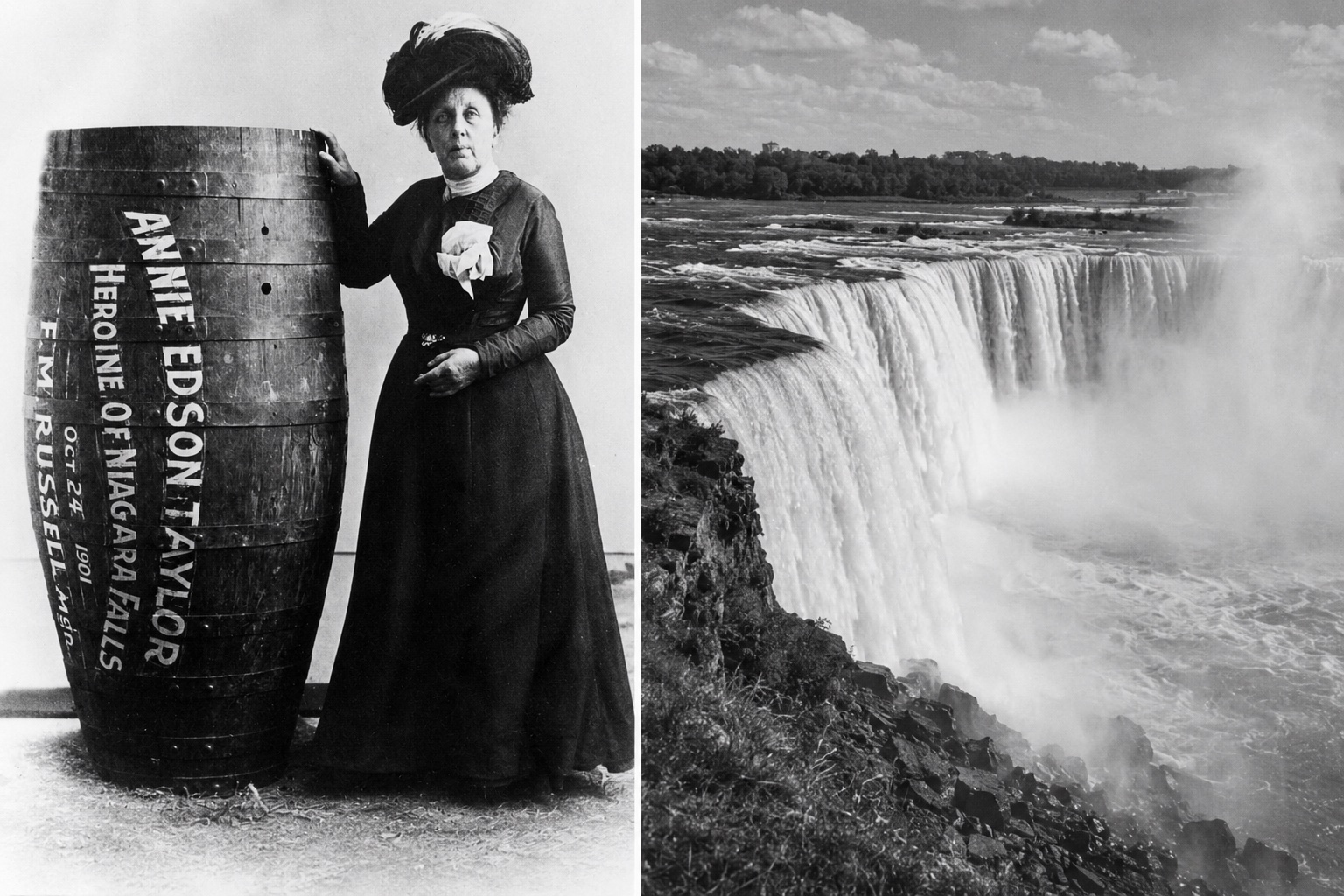
Her vessel was a custom-made contraption of her own design. Constructed of hardy Kentucky oak and reinforced with seven to ten iron hoops, the barrel stood roughly five feet tall and three feet in diameter. It was less a vehicle and more a vertical coffin. To help keep the barrel upright during its descent, it was weighted at the bottom with ballast. The interior was lined with a small mattress and a leather harness to prevent her from being violently thrown against the wood. In a final, somewhat optimistic touch, her assistants used a bicycle pump to compress the air inside the barrel before sealing the lid with a cork, hoping the extra oxygen would sustain her during the plunge.
The Feline Precursor
Before Annie would risk her own neck, she required a proof of concept. Two days before her attempt, she secured a large domestic cat—often referred to as “Iphigenia” or “Jupie”—into the barrel and sent it over the Horseshoe Falls. When the barrel was recovered and the lid pried open, the cat emerged alive, albeit with a bleeding head and a significantly diminished trust in humanity. This was all the evidence Annie needed. If a cat could survive the “Thunder of the Waters,” so could a retired schoolteacher.
October 24, 1901: The Big Birthday
On her 63rd birthday, Annie Edson Taylor dressed in her best attire—a long black dress and a flowery hat—and was rowed out to the middle of the Niagara River. Thousands of spectators lined the banks, many expecting to witness a public execution. At approximately 4:05 PM, Taylor climbed into the barrel, clenching a lucky heart-shaped pillow to her chest. The lid was screwed shut, the bicycle pump hissed its final stroke, and the barrel was cut loose from the rowboat.
For eighteen minutes, the barrel bobbed through the upper rapids. Then, it reached the brink. The barrel vanished into the mist of Horseshoe Falls, falling 167 feet into the churning cauldron below. For nearly a minute, the crowd held its breath. Finally, the barrel bobbed to the surface, appearing remarkably intact. It took another twenty minutes for rescuers to reach the craft and drag it to a rock near the Canadian shore. When the lid was removed, Annie Taylor did not emerge with a shout of triumph. Instead, she was dazed, battered, and suffering from a bleeding head wound. Her first words to the press were a grim warning:
“No one ought ever to do that again.”
The Golden Age of the Daredevil
Taylor’s stunt did not happen in a vacuum. During the late 19th century, Niagara Falls was the ultimate stage for the “Victorian Daredevil.” Before Annie, men like Sam Patch (“The Yankee Leaper”) had survived jumps from high platforms into the river, and the Great Blondin had famously crossed the gorge on a tightrope while carrying a man on his back. However, the idea of going over the actual drop in a vessel was considered the “Holy Grail” of stupidity. Previous daredevils like Carlisle Graham had only braved the Whirlpool Rapids downstream, never the falls themselves. Taylor’s success shattered many of the gendered expectations of the era and proved that surviving the physics of the falls was, under extremely specific circumstances, possible.
The Bitter Aftermath
Annie Taylor’s hope for a financial windfall proved to be her second great tragedy. Her manager, Frank M. “Tussy” Russell, made off with her famous barrel shortly after the stunt, effectively stealing her primary source of income. Taylor spent much of her remaining years and what little money she had hiring private detectives to track down the wayward oak cylinder. She eventually took to selling postcards and posing for photos with a replica barrel in a small souvenir stand near the falls.
She died penniless on April 29, 1921, at the Niagara County Infirmary. Ironically, she was buried in the “Stunter’s Rest” section of Oakwood Cemetery in Niagara Falls, resting near many of the very men whose records she had surpassed.
Modern Legacy
Today, going over Niagara Falls is strictly illegal, carrying fines of up to $10,000 and the very high probability of a gruesome death. Since Taylor’s historic plunge, only a small number of people have intentionally attempted the feat, several of whom did not survive. Annie Edson Taylor remains the first, the oldest, and arguably the most desperate of them all—a woman who traded her life for a chance at a pension, only to discover that fame is a much colder comfort than she had imagined.