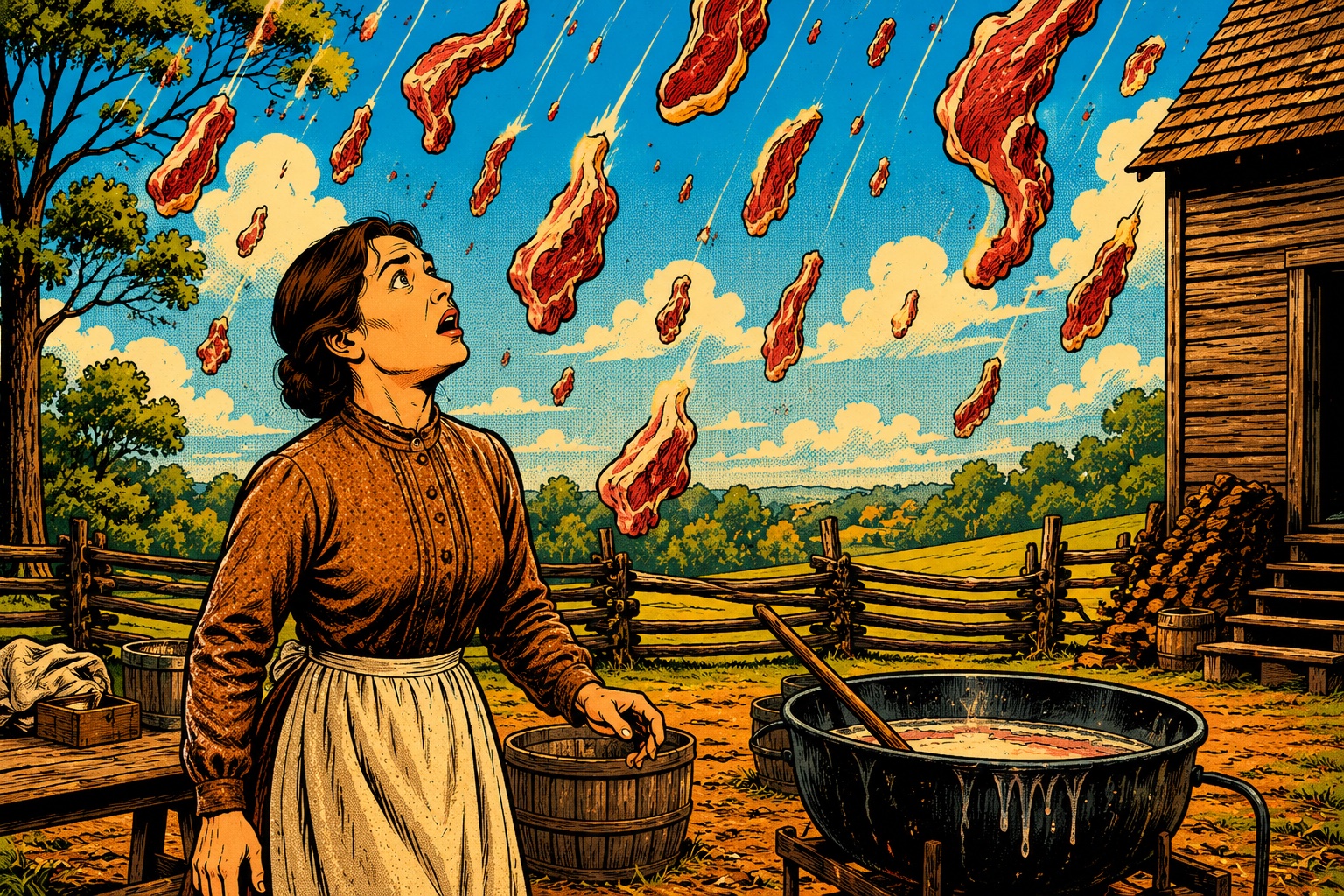
On March 3, 1876, in Bath County, Kentucky, a woman was outside making soap when the sky apparently decided to become a butcher counter.
The woman, commonly identified in reports as Mrs. Crouch, was near Olympia Springs when pieces of flesh began falling around her property. Not rain. Not hail. Not leaves. Meat. According to later summaries of the original newspaper coverage, the sky was reportedly clear at the time, which means this was not the kind of weather event anyone could reasonably blame on “storm activity” and then quietly move on with their life.
The pieces landed around the yard and fence. Some accounts described the material as looking like beef, mutton, or venison. One piece was reportedly three or four inches square. Others were smaller, but still large enough to make the whole thing less “strange mist” and more “deeply upsetting appetizer tray.”
And because history is never content to simply be strange, two men reportedly tasted the mystery meat.
This is where the story separates ordinary witnesses from men who looked at unidentified flesh from the heavens and thought, “Well, science must be done.”
They allegedly decided it tasted like mutton or venison. The Crouch family cat, showing the kind of confidence only a cat could bring to a possible biblical meat incident, also reportedly helped itself.
Thus began one of the grossest and most fascinating unsolved-ish incidents in American weird history: the Great Kentucky Meat Shower.
A Bizarre Story That Was Actually Reported
The Kentucky Meat Shower sounds like the kind of thing invented by a bored uncle at Thanksgiving after three glasses of bourbon. But the event was reported in contemporary newspapers and later discussed by scientific and medical publications.
The New York Times carried a report in March 1876 describing the strange fall of flesh in Kentucky. Scientific American later discussed the event as well, and physicians and scientists reportedly examined samples of the material.
That does not mean every detail from the story can be treated like modern forensic evidence. This was 1876. Chain of custody was not exactly “sealed evidence bag, barcode, climate-controlled lab.” Samples traveled through newspapers, doctors, curious citizens, and a general 19th-century enthusiasm for poking weird things with confidence.
Still, the story was not merely a campfire tale. It was reported, investigated, debated, and preserved in enough detail that people are still trying to explain it nearly 150 years later.
So What Was the Meat?
That is the central question, and unfortunately for everyone’s appetite, the answer appears to be: probably actual animal tissue.
Several later summaries of the scientific discussion say examined samples were identified as different kinds of tissue, including lung tissue, muscle, and cartilage. This matters because some of the less disgusting theories depended on the falling material not being meat at all.
If the stuff was just a plantlike jelly, dried frog spawn, or some other weird organic goop, the whole thing becomes easier to explain. Still odd, but less “the sky opened a deli.” But if it was lung, muscle, and cartilage, then the incident moves into a much more specific category: something animal got into the air and came back down in pieces.
The reports also disagreed on what animal the material came from. Some witnesses thought it looked like beef. Others thought mutton or venison. At least one theory involved bear meat. Another involved horse or human tissue comparisons. At this point, the mystery meat had more identity options than a bad food truck menu.
Theory One: The Sky Jelly Explanation
One early explanation suggested the material could have been Nostoc, a type of cyanobacteria that forms a jelly-like mass and can appear suddenly after rain. Historically, this kind of substance has been called “star jelly” because people sometimes believed it had fallen from the sky.
This theory has one obvious advantage: it avoids the need for airborne flesh.
It also has one large problem: the Kentucky material was repeatedly described as meat-like, and some analyses reportedly identified it as actual tissue.
Another related idea was that the material might have been dried frog spawn or some swampy biological substance picked up by wind and dropped elsewhere. Chemist J. Lawrence Smith reportedly suggested a frog-spawn-style explanation to The New York Times, arguing that wind currents could have transported it from wet areas.
That is not impossible in the broadest sense. Strange things do fall from the sky. Fish, frogs, dust, insects, and other materials have all been reported in unusual weather events. But the Kentucky case has a few details that make this theory less satisfying. The sky was said to be clear. The fall was localized. And the material was not just described as gelatinous blobs, but as pieces of flesh.
In other words, “weird pond matter” is less horrifying, but it does not explain the story as cleanly.
Theory Two: A Hoax
Could someone have staged the whole thing?
Technically, yes. Humans have always been willing to do ridiculous things for attention, confusion, money, or because someone said, “You won’t.”
But the hoax theory has problems too. The event seems to have surprised the people on the property, and samples were apparently sent out and examined. Also, if someone wanted to create a hoax, scattering raw meat around a Kentucky farm and hoping it turned into national scientific discourse seems like a strange amount of effort for an unclear payoff.
There is also the simple question of delivery. How does one secretly throw bits of meat over a yard from above in 1876 without being noticed? Were there accomplices in trees? A hidden meat cannon? A very committed neighbor with a ladder and no social life?
A hoax is possible, but it is not the most elegant explanation. And with this story, “elegant” is relative. We are still discussing sky meat.
Theory Three: Vulture Vomit
The leading explanation is also the one most likely to make readers close the article, stare into the distance, and whisper, “Of course.”
The most widely accepted theory is that the Kentucky Meat Shower was caused by vultures regurgitating partially digested carrion while flying overhead.
This explanation was proposed early. Physician L. D. Kastenbine argued in 1876 that the material may have been disgorged by vultures, noting that vultures are common in Kentucky and that they are known to vomit partially digested food when startled or threatened. Modern summaries continue to treat this as the most plausible explanation.
As gross as it sounds, it fits several pieces of the puzzle.
Vultures eat carrion. Vultures can vomit as a defensive reaction or to lighten themselves for flight. If one bird regurgitated, others may have followed. If a flock had recently fed and then passed over the Crouch property, the result could have been a sudden shower of meat-like material from an apparently clear sky.
This would explain why the event seemed to come from nowhere. It would explain why the pieces were animal tissue. It would explain why the fall was localized. It would also explain why the story feels like nature briefly let a nightmare write the weather report.
In short, Kentucky may not have experienced a supernatural meat storm. It may have simply been standing under the world’s worst flock of startled vultures.
The Preserved Sample
One of the strangest parts of the story is that a sample associated with the Kentucky Meat Shower reportedly survived.
A specimen was rediscovered in storage at Transylvania University in 2004 and is now associated with the Moosnick Medical and Science Museum in Lexington, Kentucky. The sample is reportedly kept in alcohol in a small glass vial labeled “Olympia Springs.” Modern DNA testing was attempted, but the sample was too old and degraded to identify the exact species.
That preserved sample gives the story a physical anchor. It does not solve the case, but it helps explain why the Kentucky Meat Shower remains so compelling. This is not just “somebody said something weird happened once.” There was material. People examined it. A specimen apparently survived.
Unfortunately, it has not answered the question everyone wants answered most:
What animal was it?
Why the Kentucky Meat Shower Still Fascinates People
The Great Kentucky Meat Shower endures because it lives at the perfect intersection of documented history, rural folklore, scientific curiosity, and body-horror comedy.
It is strange, but not impossible. Gross, but not meaningless. Funny, but only because enough time has passed that none of us had to be Mrs. Crouch, standing in the yard, making soap, while mystery flesh slapped into the grass around us.
It also has one of the best features of any odd historical event: the rational explanation is somehow worse than the supernatural one.
If someone said, “A portal opened in the clouds and rained meat,” that would be impossible but cinematic. If someone said, “A flock of vultures panic-vomited carrion mid-flight,” that is biologically plausible and spiritually devastating.
And that is probably why the story has survived for so long. The Kentucky Meat Shower is not just a mystery. It is a reminder that nature has a sense of humor, but it is not always a tasteful one.
Final Verdict
So, did meat really fall from the sky in Kentucky?
Based on contemporary reports and later scientific discussion, something meat-like almost certainly did fall near the Crouch property in Bath County on March 3, 1876. The exact details are hard to verify with modern certainty, but the event was reported at the time and discussed seriously enough to become more than a local tall tale.
Was it supernatural? Almost certainly not.
Was it some kind of algae, jelly, or frog spawn? Possible, but the tissue reports weaken that theory.
Was it vulture vomit?
Disgustingly, yes. That remains the leading explanation.
The Great Kentucky Meat Shower may never be solved down to the exact species, flock, and unfortunate flight path. But one thing seems clear: on one March afternoon in 1876, a quiet Kentucky farm became the site of one of the weirdest weather reports in American history.
And somewhere above Olympia Springs, a group of vultures may have committed the most memorable group stomach incident ever recorded.