In the 1920s, one of the most expensive health drinks in America came in a tiny glass bottle, promised new vitality, and contained something no modern wellness brand would dare put on the label:
Radium.
Quick Facts
- Radithor was a real 1920s health tonic made with radium dissolved in distilled water.
- It was sold as a treatment for fatigue, weakness, and sexual impotence.
- Wealthy businessman and golfer Eben Byers reportedly drank hundreds, possibly more than 1,000 bottles.
- The radium accumulated in his bones, causing catastrophic radiation poisoning.
- Byers died in 1932, and his case helped expose the dangers of radioactive patent medicine.
- The product’s maker was later ordered by the FTC to stop claiming Radithor was harmless.
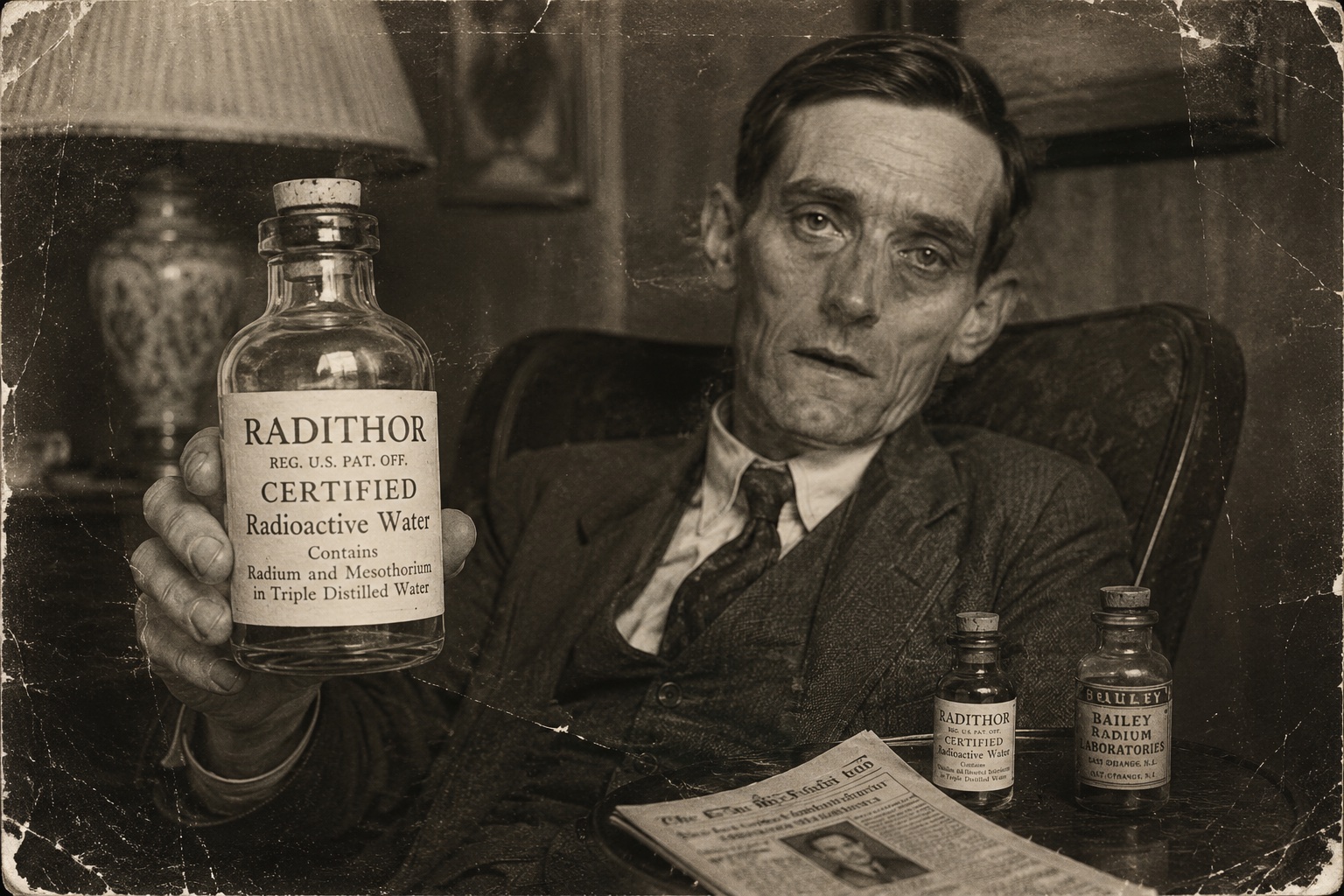
The product was called Radithor, and it was marketed as a kind of bottled energy, a glowing-age cure for fatigue, pain, weakness, sexual decline, and dozens of vague modern complaints. It was not metaphorically radioactive. It was actually radioactive. Each small bottle contained radium isotopes dissolved in distilled water, sold as medicine at a time when the public was fascinated by invisible rays, electrical cures, miracle tonics, and the new science of atomic energy.
For a while, people believed it worked.
Then Eben Byers’ jaw began to fall apart.
A Miracle Element for a Miracle Age
Radium was discovered by Marie and Pierre Curie in 1898, and the public quickly became enchanted by it. Here was a substance that seemed almost magical. It glowed. It gave off energy. It was invisible but powerful. Doctors used radiation in legitimate medical treatments, and that kernel of real science made it much easier for salesmen to build entire empires of pseudoscience around it.
By the 1910s and 1920s, radium had become a marketing dream. It appeared in health tonics, cosmetics, toothpaste, salves, devices, and “revitalizing” products. The underlying pitch was simple: if radium gave off energy, maybe it could give energy to you.
This was the age of patent medicines, when the line between doctor, salesman, chemist, and con artist could be dangerously blurry. Many Americans were already used to buying tonics that promised to cure almost everything. Some older patent medicines contained alcohol, opium, morphine, cocaine, or other substances that made people feel better temporarily, whether or not they treated anything. Federal drug regulation existed, but it was still limited. The 1906 Pure Food and Drugs Act required truthful labeling and standards of purity, but drug safety and therapeutic claims were nowhere near as tightly controlled as they would become later.
Into that world came Radithor.
“Perpetual Sunshine” in a Bottle
Radithor was manufactured by Bailey Radium Laboratories of East Orange, New Jersey. Its creator, William J. A. Bailey, was not a medical doctor, though he promoted himself with the confidence of one. He had attended Harvard but did not graduate, and he became one of the more notorious figures in radioactive patent medicine.
Radithor was sold in tiny half-ounce bottles. It was expensive, about $1 per bottle, which made it feel exclusive at a time when a dollar meant much more than it does now. According to medical historian Roger M. Macklis, more than 400,000 bottles were apparently sold worldwide between 1925 and 1930.
The product was marketed as “mild radium therapy,” but there was nothing harmless about drinking radium over and over again. Radithor contained radium-226 and radium-228 in distilled water. The sales claims were sweeping. It was advertised for “endocrinologic” problems, especially fatigue and sexual impotence, and some sources note that Radithor was promoted as a cure for more than 150 conditions.
The slogans were pure 1920s quackery. Radithor was described as “Perpetual Sunshine” and “A Cure for the Living Dead.” It was not just medicine. It was theater. A bottle of modernity. A tiny vial of the future.
And then it found its most famous customer.
Eben Byers: The Millionaire Who Trusted the Tonic
Eben McBurney Byers was not some obscure crank hiding in a back room with a bottle of miracle water. He was rich, prominent, athletic, and socially connected. Born in 1880, he was the son of an industrialist, attended Yale, became a successful businessman, and won the 1906 U.S. Amateur golf championship. He was the kind of man whose habits could influence others.
In 1927, Byers injured his arm after falling from a railway sleeping berth. For lingering pain, a doctor recommended Radithor. Byers began drinking it and reportedly felt a “toned-up” effect. That mattered. A product like Radithor did not need to cure anything to become convincing. It only needed to make a person feel something, especially if that person already believed he was taking the latest scientific tonic.
Byers became enthusiastic. He did not take one bottle and move on. He reportedly drank it regularly, sometimes several bottles a day, and recommended it to others. TIME reported shortly after his death that he sent cases to friends and even gave some to one of his horses.
By the time he stopped, he had reportedly consumed around 1,400 bottles.
That number is not just a shocking detail. It is the reason the story became a horror case in medical history. Radium behaves chemically somewhat like calcium, which means the body can deposit it in bone. Once inside, it can irradiate surrounding tissue from within. External alpha radiation is often stopped by skin, but internal exposure is a very different matter. When radium is lodged in the body, it can damage cells at close range, over and over again.
The Body Begins to Break
At first, Byers seemed to believe Radithor was helping him. But by 1930, the “toned-up” feeling had faded. Then came the symptoms.
He lost weight. He suffered headaches. His teeth began falling out. His jaw deteriorated. Eventually, the damage became so severe that a Federal Trade Commission lawyer was sent to take his statement because Byers was too ill to travel. That lawyer reported that most of Byers’ upper jaw, except two front teeth, and much of his lower jaw had been removed. He also described bone tissue disintegrating and holes forming in Byers’ skull.
This is the point where the story becomes hard to read, but it is also where careful wording matters. The popular internet version often says, “his jaw fell off.” That phrase comes from a famous Wall Street Journal headline written decades later, “The Radium Water Worked Fine Until His Jaw Came Off.” It is memorable, but it can make the case sound like folklore. The verified reality is grim enough: radiation poisoning destroyed bone tissue, led to jaw removal and severe skeletal damage, and contributed to Byers’ death.
Byers died on March 31, 1932, in Manhattan. His death was attributed to radium poisoning. He was buried in a lead-lined coffin, and when his body was exhumed decades later for study, his remains were still radioactive.
He Was Not the Only Victim
Byers became the famous face of Radithor because he was wealthy, prominent, and newsworthy. But he was not the only person harmed by radioactive “health” products.
TIME reported in April 1932 that Byers’ close friend, Mary F. Hill of Pittsburgh, had died the previous autumn of the same cause, and that other friends were worried after using the drink.
The broader radium tragedy was even larger. The best-known victims were the Radium Girls, female factory workers who painted glow-in-the-dark watch and instrument dials with radium paint. Many were instructed to shape their brushes with their lips, ingesting tiny amounts of radium day after day. They developed devastating illnesses, including jaw necrosis and cancers. Their lawsuits became a landmark in workplace safety and occupational disease law.
Together, these stories exposed a horrifying truth: radium was not a magical life force. It was a dangerous radioactive element being handled, sold, swallowed, painted, and marketed with breathtaking recklessness.
The Salesman Behind the Bottle
William J. A. Bailey’s story adds another layer of absurdity to the case. He was not merely selling a questionable tonic. He built a business around the idea that radioactivity could be packaged and consumed.
Radithor’s marketing leaned heavily on medical-sounding language, and physicians were reportedly offered financial incentives for prescribing it. According to accounts of the product’s history, Bailey offered doctors a cut on each dose prescribed. This gave Radithor a veneer of medical legitimacy while turning prescriptions into a sales channel.
After Byers’ death, the Federal Trade Commission moved against Bailey’s company, ordering it to stop making certain claims about Radithor’s therapeutic value and harmlessness. ORAU’s Museum of Radiation and Radioactivity notes that one of Bailey’s guarantees, that Radithor was “harmless in every respect,” proved false in the most dramatic way possible.
Yet Bailey’s story did not end with Radithor. He later marketed other radioactive products, including devices and objects that allegedly carried health benefits. That detail is almost too perfect for the era: after one radioactive health product became linked to a millionaire’s gruesome death, the salesman simply moved on to other glowing promises.
Why Did Anyone Believe This?
From a modern perspective, drinking radium sounds insane. But to understand the craze, you have to step into a world where radioactivity was new, poorly understood by the public, and wrapped in the glamour of discovery.
Electricity had transformed daily life. X-rays seemed miraculous. Radio had made invisible waves feel ordinary. Scientific breakthroughs were happening fast, and people were eager to believe that the next invisible force might cure fatigue, aging, pain, and sexual anxiety.
Radium also had one priceless quality for marketers: it seemed active. It glowed. It emitted energy. In an age obsessed with vitality, that made it easy to sell as bottled life.
Radithor was especially clever because it did not look like a back-alley potion. It looked modern. It sounded scientific. It was expensive. Doctors recommended it. Wealthy people used it. The danger was not that it seemed obviously ridiculous. The danger was that it seemed respectable.
Did Byers’ Death Change the Law?
Byers’ death did not single-handedly create modern drug regulation, but it did become one of the most notorious examples of why stronger oversight was needed. The scandal helped discredit radioactive patent medicines and prompted stronger regulatory attention toward radiopharmaceuticals and health claims.
At the time, federal regulators had limited tools. The 1906 law focused heavily on adulteration, misbranding, and truthful labeling. The 1912 Sherley Amendment addressed false therapeutic claims, but regulators generally had to prove claims were false and fraudulent, which was a high burden. The much stronger Federal Food, Drug, and Cosmetic Act would not arrive until 1938, after another public health disaster involving Elixir Sulfanilamide killed more than 100 people.
So Radithor belongs to a transitional moment in American consumer protection: late enough that regulators were paying attention, but early enough that a man could still sell radioactive water as a vitality tonic and get very rich doing it.
The Bottle That Promised Life and Delivered Death
The Radithor story is disturbing because it is not just a tale of one foolish product. It is a story about what happens when real science becomes marketing before the public understands the risk.
Radium was real. Its medical potential was real in certain controlled contexts. Its danger was also real. But in the hands of patent medicine salesmen, “energy” became a sales pitch, “radiation” became a lifestyle ingredient, and a tiny bottle of water became one of the most infamous health products in American history.
Eben Byers did not die because he rejected science.
He died, in part, because he trusted something that sounded like science.
That may be the strangest and most modern part of the whole story.
Sources
- Oak Ridge Associated Universities, Museum of Radiation and Radioactivity: Radithor
- JAMA: “Radithor and the Era of Mild Radium Therapy”
- U.S. Nuclear Regulatory Commission: Backgrounder on Radium
- FDA History: 1906 Food and Drugs Act and Federal Food, Drug, and Cosmetic Act
- TIME Archive: “Medicine: Radium Drinks,” April 1932
- Scientific American / Roger M. Macklis: “The Great Radium Scandal”
- ORAU: Radium Girls historical overview