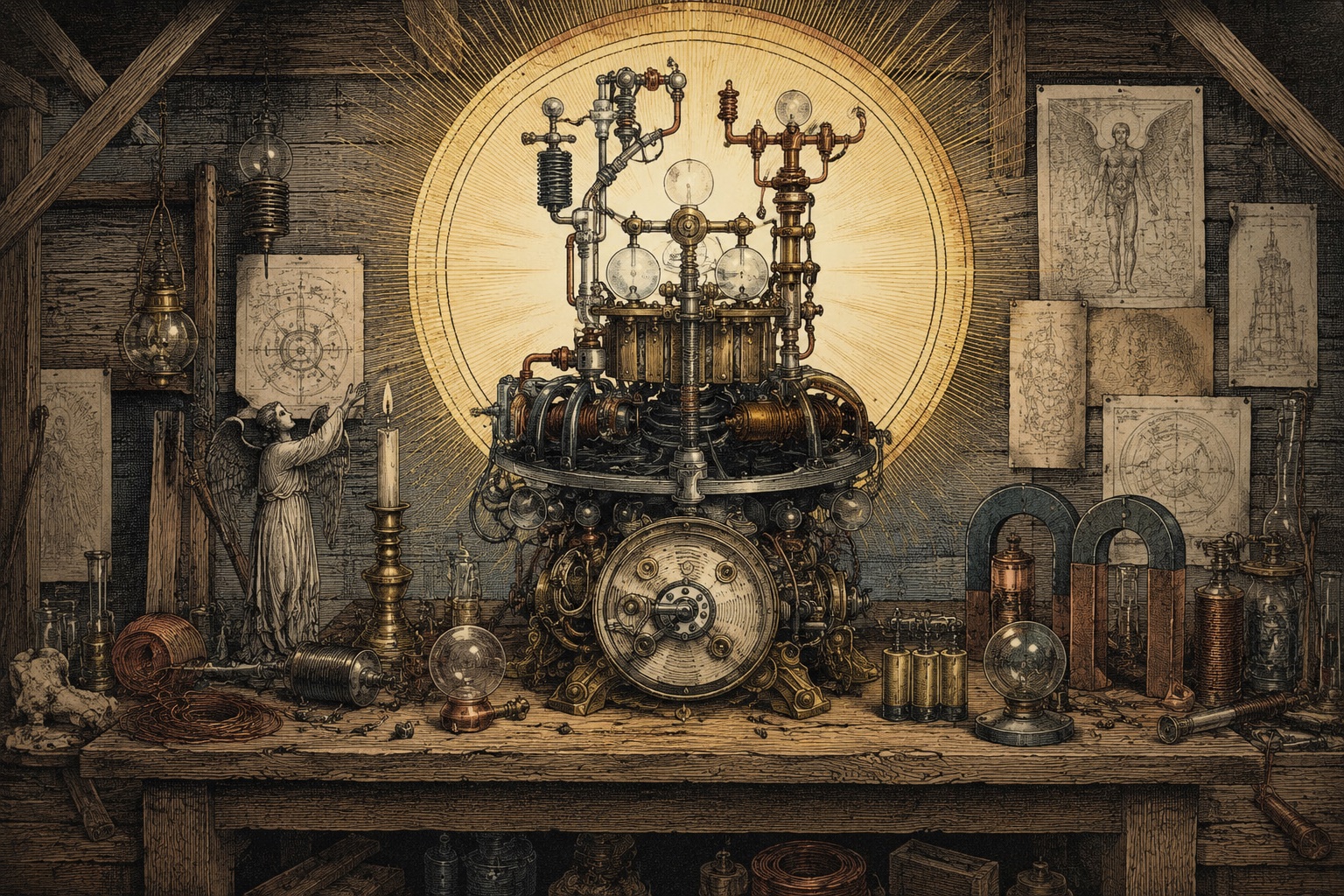
In the mid-19th century, on a rocky hill in Lynn, Massachusetts, a former minister gathered his followers around a table covered in copper, zinc, magnets, and hope.
They were not building a normal machine.
At least, not according to John Murray Spear.
Spear believed he had been chosen by spirits from the next world to construct a new kind of power source, one that could draw energy from nature itself and help usher humanity into a new age. His followers called it the New Motive Power. Others would later remember it by stranger names: the New Motor, the Mechanical Infant, the Mechanical Messiah, and, in modern retellings, the God Machine.
It was part invention, part séance, part religious prophecy, and part 19th-century fever dream.
And for a brief moment in 1854, a small group of Spiritualists in Massachusetts believed they had helped give birth to a machine that might save the world.
The Minister Who Became a Medium
John Murray Spear was not born into obscurity or madness. He was born in Boston in 1804 and built his early life around religion, reform, and public service. He became a Universalist minister and spent much of his career fighting for causes that were radical for his time. He opposed slavery, supported prison reform, argued against the death penalty, and advocated for women’s rights, labor reform, pacifism, and other social causes. He was also connected to major reformers of the era, including William Lloyd Garrison and Theodore Parker.
In other words, before he became known as the man who tried to build a machine messiah, Spear was known as a serious reformer.
That makes the next part of his life stranger, not less.
By the early 1850s, Spear had broken away from the Universalist church and turned toward Spiritualism, a movement that had exploded in popularity after the Fox sisters helped popularize “spirit rappings” in 1848. Spiritualism promised that the dead were not silent. They could knock. They could speak. They could write through mediums. And, in Spear’s case, they could apparently design machinery.
Spear claimed he had been contacted by a group of spirits known as the Association of Electricizers. This was no ordinary ghostly committee. According to accounts of Spear’s claims, it included figures such as Benjamin Franklin, Thomas Jefferson, John Quincy Adams, Benjamin Rush, Socrates, and John Murray, the founder of American Universalism and Spear’s namesake.
Benjamin Franklin, naturally, was a key figure in the story. Because if you are going to receive instructions for a spirit-powered electrical device, it helps if the ghostly engineering department is led by the man with the kite.
The Association of Electricizers
The spirits, Spear said, had selected him for an extraordinary mission. He was to help bring a new technology into the world: a machine that would draw from the “magnetic” forces of nature and provide a new form of power for humanity.
This was not supposed to be merely a better engine. Spear and his followers saw it as something much larger. The machine was described as a “physical saviour of the race” and a “new messiah.” It was supposed to liberate humankind from drudgery, labor, and the old social order.
To modern ears, this sounds like science fiction wearing a preacher’s coat. But in the 1850s, the line between science, religion, electricity, magnetism, and the spirit world was blurrier than it is today.
The telegraph had recently changed the world. Messages could now travel invisibly through wires over long distances. Electricity seemed mysterious, powerful, and almost supernatural. If a wire could carry words across a continent, it did not feel entirely impossible to many Spiritualists that invisible forces might also carry messages from the dead.
Spear’s followers believed the spirits were not just offering comfort from beyond the grave. They were offering technical instructions.
Through trance communications, Spear claimed to receive directions for a new device. He and other believers interpreted those messages into physical form, assembling a machine made of copper, zinc, magnets, metallic balls, and other components.
It was to be less like a steam engine and more like a living organism. It would not simply burn fuel and move parts. It would, according to its believers, draw power from the living energies of nature.
The Gestation at High Rock
The chosen birthplace of the machine was High Rock in Lynn, Massachusetts, a hilltop site now associated with High Rock Tower Park. According to later accounts, Spear and a small group of followers worked there in a wooden shed or structure near the summit, constructing the New Motive Power under spirit guidance.
The timeline mattered. The machine’s construction was said to have taken about nine months, a period that Spear and his followers treated as symbolic. This was not just fabrication. This was gestation.
The machine was built around a table and fitted with materials associated with electricity and magnetism. Accounts describe copper, zinc, magnets, plates, rods, metallic balls, and other pieces that gave the device the appearance of a strange hybrid between laboratory apparatus and sacred object.
Some accounts say the project cost around $2,000, an enormous sum for the time. That number is widely repeated in later tellings, and whether exact or rounded, it reflects something important: Spear’s followers were not treating this as a parlor trick. They invested real money, time, and belief into it.
To them, the machine was growing.
To everyone else, it was a pile of metal on a table.
But then came the birth.
The Birth of the Mechanical Infant
In 1854, the project reached its strangest moment.
A woman connected to the Spiritualist movement, commonly identified in historical accounts as Mrs. Alonzo Newton, became known in the story as the New Mary. She reportedly participated in a ritualized birth of the machine at High Rock, experiencing what followers described as labor pains beside the device for roughly two hours.
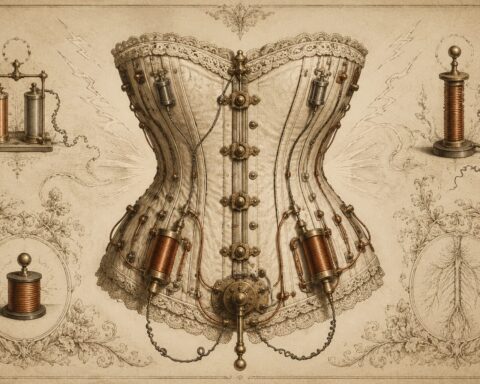
Spear himself reportedly wore a special outfit featuring metal and, in some accounts, gemstones as part of the ritual. His role was not just an inventor. He was a medium, a priest, a technician, and a midwife to a machine that was supposed to be alive.
After the ritual, followers claimed the machine showed signs of life. Some said they sensed or observed a faint pulsation. In a normal workshop, this would have been unimpressive. In Spear’s circle, it was treated as proof that something extraordinary had occurred.
The Mechanical Infant had been born.
But there was a problem.
It did not do anything.
The New Motive Power never delivered endless energy. It did not remake society. It did not free humanity from labor. It did not become the electrical savior of the race. At most, according to later summaries, observers reported slight movements or oscillations in parts of the machine. One disappointed Spiritualist allegedly complained that it could not even turn a coffee mill.
That may be the most devastating review in the history of religious technology.
A Machine Without a Miracle
The failure did not immediately end Spear’s belief. Like many prophetic movements, disappointment became something to explain, not something to surrender to.
The machine was eventually moved to Randolph, New York, in hopes that different spiritual or atmospheric conditions might allow it to function. This part of the story gets murkier. According to some accounts, the machine was later destroyed by a hostile mob. Other versions describe the destruction as local legend or as an event that is difficult to confirm through surviving records.
That distinction matters. The machine itself was real as an object of belief and attempted construction. The mob destruction is part of the traditional story, but it should be treated carefully: reported, not overclaimed.
Spear did not abandon Spiritualism after the failure. He remained involved in spiritual and reform movements for years and reportedly retired from mediumship in 1872. He died in 1887.
The New Motive Power, meanwhile, vanished into history, leaving behind no working engine, no surviving machine, and no new age of spiritually powered utopia.
What it did leave behind was one of the most bizarre episodes in American religious history.
Why the Story Still Feels So Strange
The story of John Murray Spear’s God Machine survives because it sits at a perfect historical crossroads.
It belongs to the age of Spiritualism, when séances were fashionable and the dead seemed newly reachable. It belongs to the age of reform, when abolitionists, prison reformers, feminists, pacifists, and utopian thinkers imagined society could be radically remade. And it belongs to the age of technology, when electricity felt like a half-discovered miracle.
Spear’s mistake, if we want to call it that, was combining all three.
He did not simply believe spirits existed. He believed they were engineers.
He did not simply believe machines could change the world. He believed a machine could be born, animated, and spiritually consecrated.
He did not simply want power. He wanted salvation with copper wiring.
Today, High Rock Tower Park is better known for its views than for the strange ritual that allegedly took place there. There is no functioning Mechanical Messiah waiting to be rediscovered, no hidden engine humming beneath the hill, no lost spiritual battery ready to turn on and free humanity from work.
But for nine months in 1854, John Murray Spear and his followers believed they were building the future.
Not a factory machine.
Not a steam engine.
A savior.
And that may be the strangest part of all: the machine failed, but the dream behind it was completely modern. A belief that technology could redeem humanity. A hope that the next invention might solve suffering itself. A faith that somewhere, just beyond the edge of the known world, there was a device waiting to save us.
John Murray Spear never built that machine.
But he may have built one of America’s weirdest warnings about believing too much in the next big thing.